Lou Salomé Sorlin s’est particulièrement engagée dans la défense des droits des personnes exilées, notamment des mineurs non accompagnés présents dans la « Jungle » de Calais. Son action s’inscrit dans un contexte où les procédures d’asile restent longues, complexes et difficiles à comprendre pour les demandeurs qui ne maîtrisent ni la langue française ni les démarches administratives.
Cette journée de réflexion a débuté par un panel qui a réuni l’Ambassadeur de France au Liban, S.E. M Bruno Foucher, le Dr Xavier Emmanuelli, le Dr Kamel Mohanna, l’un des membres du Conseil Consultatif de la FACM, M Nikolaos Poutsiakas ainsi que la Directrice d’Un Ponte Per, Mme Novella Mori.
A cette occasion, le Dr Xavier Emmanuelli a rappelé que « le monde entier est sur les routes. Le Dr Kamel Mohanna a pour sa part insisté sur l’importance de prévenir les conflits et de mettre en œuvre, avec et pour les populations en situation d’exil des « partenariats Sud-Nord et des actions de solidarité, s’inscrivant à contre-courant du populisme et d’un monde qui perd son humanité ».
La demande d’asile en France
France recently passed a reform to its immigration law for refugees & asylum seekers.
People can apply for a long term visa on the grounds that they are looking for asylum in France (visa de long séjour délivré au titre de l’Asile) at a French embassy outside of France.
Even though most applications are rejected, it is an option to consider if someone has a strong case to prove (official documents, solid proof that they have suffered (or fear) persecution on account of race, religion, nationality, belonging to a group or political opinion).
If already in France, asylum seekers must apply by visiting the Prefecture, the regional institution representing the French State in each of France’s regions, with the right documents in hand.
At the Prefecture, each person will be given a form to fill out to go along with that person’s administrative documents.
At the prefecture, a person must make sure their application is complete, that nothing is missing.
If the prefecture refuses the right to stay in France on one of the grounds quoted above - and so refuses the right for the applicant to apply for asylum to the OFPRA, a person’s options to apply to asylum in France are restricted.
If the reason for refusal is because of the application being handled by another EU country (Dublin II ruling), the applicant is not allowed to apply for asylum in France at this stage.
Les critères permettant de demander la protection
The applicant needs to articulate strongly the reason why he/she is fleeing his/her country and the reasons why they can’t go back - reasons that are clearly relevant to what defines a refugee: someone, owing to wellfounded fear of being persecuted for reasons of race, religion, nationality, membership of a particular social group or political opinion,who is outside the country of his nationality and is unable or, owing to such fear, is unwilling to avail himself of the protection of that country;someone, owing to wellfounded fear of being persecuted for reasons of race, religion, nationality, membership of a particular social group or political opinion,who is outside the country of his nationality and is unable or, owing to such fear, is unwilling to avail himself of the protection of that country.
It is expected that the applicant provide as many details as possible about the cause of their departure from their country, the circumstances around how it happened, the risks and persecutions he/she could potentially be subjected to if they were sent back to their country without any questions from the judges or administrators.
All documents that support the personal and family details as well as prove the reasons why the applicant is eligible for refugee status.
The more documents, if relevant, the better.
It is important to know that the application information is confidential.
It is strongly recommended that an applicant keep a copy of all and any documents provided with the application.
Le rôle de la préfecture et de l’OFPRA
When the applicant receives the APS from the prefecture, they should start working on their application to OFPRA (l’Office français de protection des réfugiés et apatrides) with the help of French migrant associations and/or lawyers.
The asylum application must be filled out and written in French.
The OFPRA form has to be filled out completely - without any gaps.
The legal process can fail asylum seekers non familiar with administrative papers and procedures.
The process requires knowledge of the administrative system.
There are options to appeal that are not known by asylum seekers.
It requires an expert or legal advisor to best understand and navigate what can look like an obscure system for applicants.
A little knowledge can actually be worse than no knowledge at all - and lots of people say lots of confusing things.
Applicants would benefit from looking for advice from migrant organisations and/or lawyer networks.
Refugees should know that they can access the services of free lawyers and free support from migrant associations when at the stage of court proceedings.
L’entretien devant l’OFPRA
It is very rare for an applicant to be granted asylum successfully without having to pass an interview with the OFPRA.
The interview is performed in the language the applicant prefers and that the applicant has mentioned on the application form.
As such, it is important for the applicant to choose the language he/she feels most comfortable with.
The in person interview follows less the format of an interview than a presentation exercise where the applicant must convince officials who often have little knowledge or access to information on the situation or the cultural and political background of the applicant.
Taking French language classes ahead of the interview or while waiting for the decision, makes it significantly easier to get familiar and feel comfortable with the process.
The administration often asks for documents and evidence that are difficult for asylum seekers to provide.
France and the asylum seeker have 6 months maximum to make a decision on the case.
The process is long.
On average it takes 16 months to be granted refugee status in France.
The new legislation aims to reduce this process to 9 months maximum by 2017.
The new legislation grants the right to work to asylum seekers after 9 months even if no decision has been taken on their application by the OFPRA.
| Élément de la procédure | Information |
|---|---|
| Dépôt de la demande en France | Visite de la Préfecture |
| Office compétent | OFPRA |
| Durée moyenne mentionnée | 16 mois |
| Objectif de la nouvelle législation | 9 mois maximum by 2017 |
| Droit au travail | Après 9 mois si aucune décision n’a été prise par l’OFPRA |
Les recours devant la CNDA
Indeed, the right to asylum is stated in the French constitution - it is one principle of its Republic.
The Cour Nationale du Droit d’Asile (CNDA) is the result of this commitment and guarantee of the right.
When an applicant is refused the right to asylum by the OFPRA, he/she can appeal to the CNDA.
The statistics states that a large number of applicants are being granted refugee status after appeal to the CNDA.
This time a translator and lawyer are provided automatically.
An asylum seeker can contest the procedure of deportation to the another EU country with a lawyer if they have valid grounds to contest it.
Last January 2011, the EU court of Human rights ruled and fined Belgium and Greece for degrading and inhuman treatment of asylum seekers.
Also, for humanitarian reasons, asylum seekers are not detained systematically - and the refugee status is granted for ten years, and is easily renewed.
A travel document is provided to any refugee that wants to leave France.
Lou Salomé Sorlin et la situation des mineurs à Calais
Some 326 lone children - minors from Afghanistan, Syria, Egypt and Eritrea - are living in the "Jungle" of Calais, according to the refugee body France Terre d'Asile.
Now the Jungle is disappearing around them.
The church is gone; the mosque is gone; some of the community areas where young people could gather during the day are gone.
So far, 1,200 of the 4,000 to 6,500 people that volunteer associations say live in the Jungle - an insalubrious collection of tents and huts concentrated on a wind-lashed wasteland - have been moved to a nearby site.
No provision, however, has been made for the lone foreign kids - young girls as well as boys - that takes account of their multiple vulnerabilities and their particular protection needs.
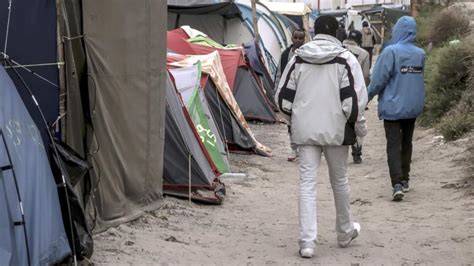
Minors, less adept at assessing risk, are vulnerable to alcohol and drug abuse, and exposed to the predations of traffickers for sex and other forms of slavery.
Minors in the Calais Jungle, they said, suffered respiratory illnesses, eye damage from exposure to tear gas, and dental problems owing to poor diet and hygiene conditions.
They missed out on vaccinations, suffered from poor sleep and inadequate clothing that included wet shoes and socks, and sometimes had no socks at all.
Their ability to concentrate was deteriorating.
Trauma provoked anxiety attacks and sometimes bedwetting.
Violences, traumatismes et vulnérabilités
"You see it in what they express in therapy: they've been the victims of torture, or they've crossed the sea and seen their parents die, or they've been pushed onto dangerous boats,'' she said.
"Some are in hospital for weeks because of police violence, and that includes minors,'' she said.
"Several have been attacked by fascist thugs and ended up in hospital.
"People who flee a country at war should be protected by France, yet they find themselves being clubbed by the police,'' she said.
Numerous children and adults have been killed trying to cross the Channel Tunnel to Britain.
Cette situation met en évidence la nécessité d’une protection adaptée aux enfants isolés, indépendamment de leur âge, de leur nationalité et de leur parcours migratoire.
Le règlement Dublin II et le regroupement familial
Sorlin and Fabié sought the court's help in upholding the so-called Dublin II regulation, which determines responsibility among EU countries in asylum affairs.
"This is not an option, it's a right, and it should be automatic,'' said Sorlin in an interview, adding that on the eve of the court's ruling, France hurried to comply with the law by beginning the steps that would allow the five children to travel.
Unaccompanied minors arriving in Greece, for instance, would be able to join a legally resident family member anywhere in Europe, she added, without having to gamble their lives or put them in the hands of smugglers.
Some hope he might consider sheltering them as part of the 20,000 refugees he has promised to take in from the refugee camps close to the Syrian border.
La solidarité envers les populations en exil
Le Dr Kamel Mohanna a pour sa part insisté sur l’importance de prévenir les conflits et de mettre en œuvre, avec et pour les populations en situation d’exil des « partenariats Sud-Nord et des actions de solidarité, s’inscrivant à contre-courant du populisme et d’un monde qui perd son humanité ».
Les associations de migrants et les réseaux d’avocats peuvent aider les demandeurs à comprendre les documents, préparer leur dossier, se familiariser avec l’entretien et connaître les voies de recours.
La défense du droit d’asile repose ainsi à la fois sur les garanties juridiques, l’accompagnement administratif et la protection concrète des personnes vulnérables, en particulier des enfants isolés.